
I Live In Tokyo Part-time (here’s how)
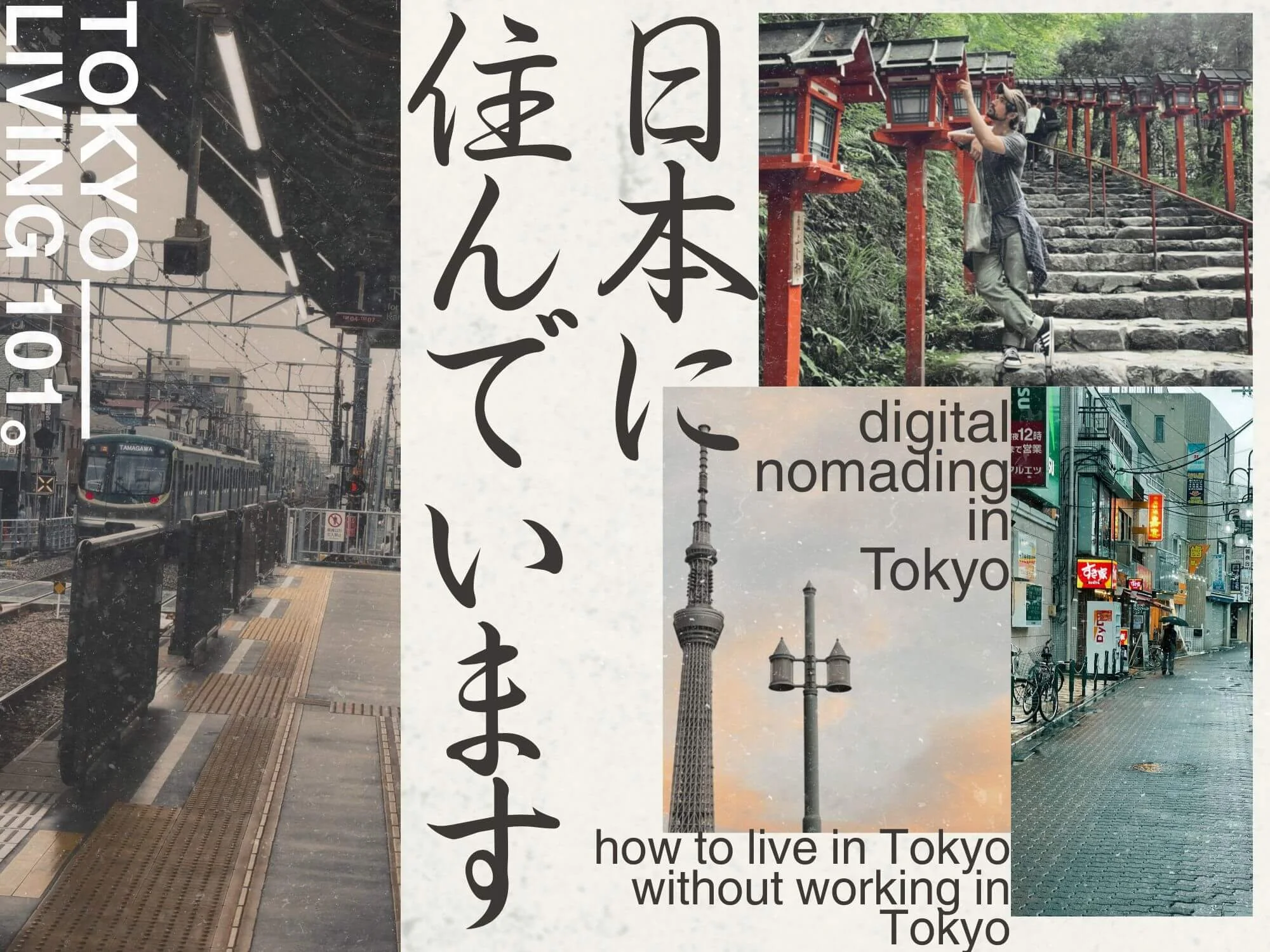
Japan is my second home. It’s comfortable and exciting and I keep coming back. Maybe it’s the safety or the rich culture…or all the lifelong friends I’ve made. The international art scene is great too.
Whatever the case, one thing is crystal clear: I freaking love living in Tokyo (even if it’s just part-time).
So I put together this quick guide on how I do it. But if you want more information on how to become a digital nomad, check out my full (free) course here.
Otherwise, let’s get to it!
Table of Contents
Hey there, just a heads up some links in this post may be affiliate links, which earn me a small commission. This is at no extra cost to you, but helps me keep the lights on. Thanks for your support!
Why I Started Living In Tokyo
After college, I had no idea what I wanted to do. I moved to Colorado for a bit to snowboard. But I always felt a pull to hop on planes. My older brother lived in Seoul at the time too, which inspired me.
So by 2017, I decided to make the move to Japan. But not as a part-timer, as a full-time English teacher. That’s where my Japan journey began.
I used to teach at a popular eikaiwa (conversation school) in Tokyo. It was a great experience, but the pandemic forced me to change. My contract ended in March 2020, so I decided to move back to America for a few months to “ride it out” (little did I know I’d be stuck there for nearly 2 years…).
So I was forced to pivot.
Now, I live in Japan part-time and I no longer work for a Japanese company (aka, more freedom and flexibility). I have no work visa and I’m not special. This post shares how I’m doing it.
(note: I am not against working at Japanese company full-time either— — it’s an awesome way to move here and get overseas experience)
Required Visa for Staying In Japan Part-time
I just use the tourist visa to stay in Japan part-time. It’s the simplest visa-on-arrival stamp you can get and lets me stay in Japan for up to 90 days (each visit).
I don’t need to apply for anything or plan ahead. I just show up in Japan and they stamp my passport.
But keep in mind that I have an American passport.
So your situation might be different depending on your nationality. Always do your own research and double check things like entry requirements and how long you can stay in Japan as a tourist.
Also remember that you’ll need to have proof of onward travel when arriving in Japan (or any country) as a tourist. This just means you have already purchased a return ticket or another flight out of the country before your tourist visa expires. We need to prove that we actually intend to leave the country and not stay illegally. Don’t stay illegally lol.
You can always cancel or change your proof-of-onward ticket also (as long as you still leave the country before your visa expires, obviously).
Japanese immigration or customs have never asked me for proof of this ticket, but the airway staff at check-in sometimes do.
Wait, Can You Work In Japan On a Tourist Visa?
No, you cannot work for a Japanese company or earn Japanese yen on a tourist visa in Japan. But I earn money from overseas clients online as a freelancer (as well as miscellaneous income from my blogs and creative projects).
So, technically I’m in the clear…I think.
The information on working in Japan on a tourist visa as a freelancer (aka, NOT for a Japanese company) is a little murky (legal jargon oof). But I’ve never had any issues or questions about how I afford to stay in Japan for so long or whether I work remotely here. When I’m asked why I’m visiting for so long (sometimes by American immigration officers when returning home), I just say for tourism and exploring.
If you’re worried, contact an actual Japanese immigration law expert or explore the official MOFA website for more information. But again, the wording is a little confusing and from my understanding, as long as you’re not working for a Japanese company or earning money directly in Japan, you should be fine.
But I also don’t make it a point to mention any work-related stuff when going through immigration (not that they ask). They usually just look tired and apathetic lol.
But there could be a more compelling reason I’m never questioned: I don’t overstay my welcome by staggering my visits according to the actual law.
So let’s keep moving.
How Often Can You Come to Japan On a Tourist Visa?
Technically, you cannot be in Japan for than 180 cumulative days in a given 1-year period. I never stay in Japan for more than 6 months in a given 1-year period.
It’s not clear when that 1-year period starts or ends (e.g. is it a calendar year starting January 1st or based on your first entry into Japan for that year?), but I usually just aim to average about 6 months from January to December.
I usually stay in Japan:
For 3 months in the spring and then 3 more months in the fall (these are the best times to be in Japan)
For 6 months back-to-back (with a short visa run trip to Seoul for a weekend in between each three-month stint)
I imagine if I were to continually do a visa run every 3 months multiple times in a row, someone would eventually say something. So I’d rather not test that.
Accommodations: Where I Stay In Japan
I stay in share houses when I come to Japan.
These are super flexible short-term (or long-term) rental options that are foreigner-friendly and ubiquitous in places like Tokyo.
Usually, there’s a one-month stay minimum and you generally do not need a special visa to stay in one. Some will have age restrictions (below 40, for example), but many do not.
Share houses are also great because you get an instant community of friends and locals. This is perfect if you’re a solo traveler. You’ll usually need to share the kitchen, sinks and toilet/shower rooms, but I’ve always had a great experience.
I usually use Oakhouse for my Tokyo accommodations — — I can vouch for them as a solid company.
Explore more:
➤ Best Share Houses in Tokyo
Logistics for Living in Japan Part-time

Phone / eSIM
It’s super easy to get a SIM/eSIM card. You can grab one after arrival at the airport (unless the booths are closed) or order online before you leave (using Mobal, for example).
Recently, I’ve been using an international plan from my home country carrier. It’s easier and not too expensive.
Health Insurance
Travel/health insurance is not required to enter Japan, but it is recommended.
I use SafetyWing for my travel/health insurance abroad. They’re super convenient, reliable and work like a subscription plan.
You can stop and start your policy at any time (even if you’re already overseas). You get solid coverage for all the important stuff and peace of mind.
Explore more:
➤ SafetyWing vs. World Nomads here.
Train Cards + Credit Cards
There are a few popular options for train cards in Japan, including Suica, Icoca and Pasmo.
I use a Suica train card for transportation (and for paying at stores and shops, like a debit card).
But I also often just use my bank card from back home and other credit cards I have (especially if I get travel points).
I use 711 ATMs to take out money too (so I always have some cash on hand; for example, some restaurants and many train ticket machines are cash only).
Obviously, there are extra fees for using your home credit cards and taking out cash often, but honestly, this isn’t breaking my budget. And I’m too lazy to find other options.
If you are worried about these extra fees though, that’s totally normal. So you can look into getting an international card like the Revolut travel money card or Wise currency card.
But they’re not necessary.
(and most places, especially in Tokyo, accept card and digital payments these days)
Taxes (back home)
I don’t need to pay Japanese federal taxes (obviously, I’m just a tourist). But I do need to pay taxes back home in America…even though I barely live there.
I usually just use my parent’s home address as my permanent address since I’m quite nomadic and have no condo or apartment I own or rent long-term when I’m traveling. So when taxes come, I just use that address (even though I’m barely living there).
This can be annoying, especially if I end up owing local or regional taxes. But I’m too lazy and laid-back to find a better solution. Keep in mind, I AM NOT A TAX PROFESSIONAL. So do your own research here to find the best solution for your situation and goals.
How to make money while living overseas
To live in Japan part-time, you’re essentially living the nomadic lifestyle. And the big elephant in this proverbial room is money.
Obviously, you need to eat and pay rent and you probably have some bills too. You still need to make money while traveling around and living abroad.
You can read about how I make money as a digital nomad here. But in my experience, there are 3 main paths to making money abroad:
Find remote work
Get a job in Japan
Start a remote business / become an entrepreneur
If you’re serious about the nomad life, then check out my free course here, which goes deeper into everything I talked about in this post.
Otherwise, that’s a wrap——thanks for reading and hope to see you in Tokyo!
Later ✌️
Want More? Nice. Here’s More.



Make your Japan plan good.