How to Build the Perfect Japan Itinerary: 11 Pro Tips
Your Japan itinerary should still feel like you…
(psst, don’t forget to pin this for later!)
I LOVE planning trips back to Japan. Buying the tickets, mapping out the spots, flipping through photos of where I’ll be sleeping. It’s freaking fun.
Well, it’s fun right up until you open a blank Google Doc and realize you have 10 days, 10,000 things you want to do, and zero motivation to make it all make sense.
Luckily we have AI. But without the right instructions, it won’t be that good.
So this post outlines my favorite hacks for how to plan the perfect Japan itinerary.
And who am I to be saying this anyways? I’ve been living in Tokyo (on and off) since 2017. I used to teach English there, now I live there part-time.
So let’s do this!
1. Plan Around Your Style + Personality
Most Japan itineraries are built around what everyone else does. Tokyo → Kyoto → Osaka, hit the greatest hits, done. And look — that route exists for a reason. But the best trips are built around you.
Are you a foodie? Your itinerary should look completely different from someone who's there for anime culture or hiking or nightlife or street fashion. Before you plan a single day, ask yourself: what do I actually love in everyday life? Japan has a world-class version of almost everything. Start there.
A trip built around your personality isn't just more fun — it's more memorable. You're not checking boxes. You're collecting experiences that actually matter to you.
2. Don’t Overload It
The classic first-timer mistake. You've got 10 days, you've been researching for months, and you want to see everything. So you pack 6-8 things into every single day and call it efficient.
Then day 3 hits and you're exhausted, rushing through experiences you waited months to have, and the anxiety of being "behind schedule" is quietly ruining everything.
Two to three major experiences per day is the sweet spot. Leave gaps. Leave some days deliberately light — or even empty. The empty space isn't wasted time. It's where the best stuff actually happens.
Don’t pack each day to the brim and leave some days chill (or even empty).
3. Set a Theme for Each Day
Instead of a rigid hour-by-hour schedule, give each day a loose identity.
"Today is a slow, local day." "Today is full foodie mode." "Today I want to get lost somewhere I've never heard of."
Then build a shortlist of experiences that fit that vibe — and on the day, choose from the list based on your energy, the weather, how your body feels after four days of travel. Raining? You've got indoor options ready. Feeling energetic? You've got the longer option on the list.
This approach saves hours of planning time and makes the actual trip way more enjoyable. You're not managing a schedule. You're choosing from a menu of things you already know you'll love.
4. Automate It
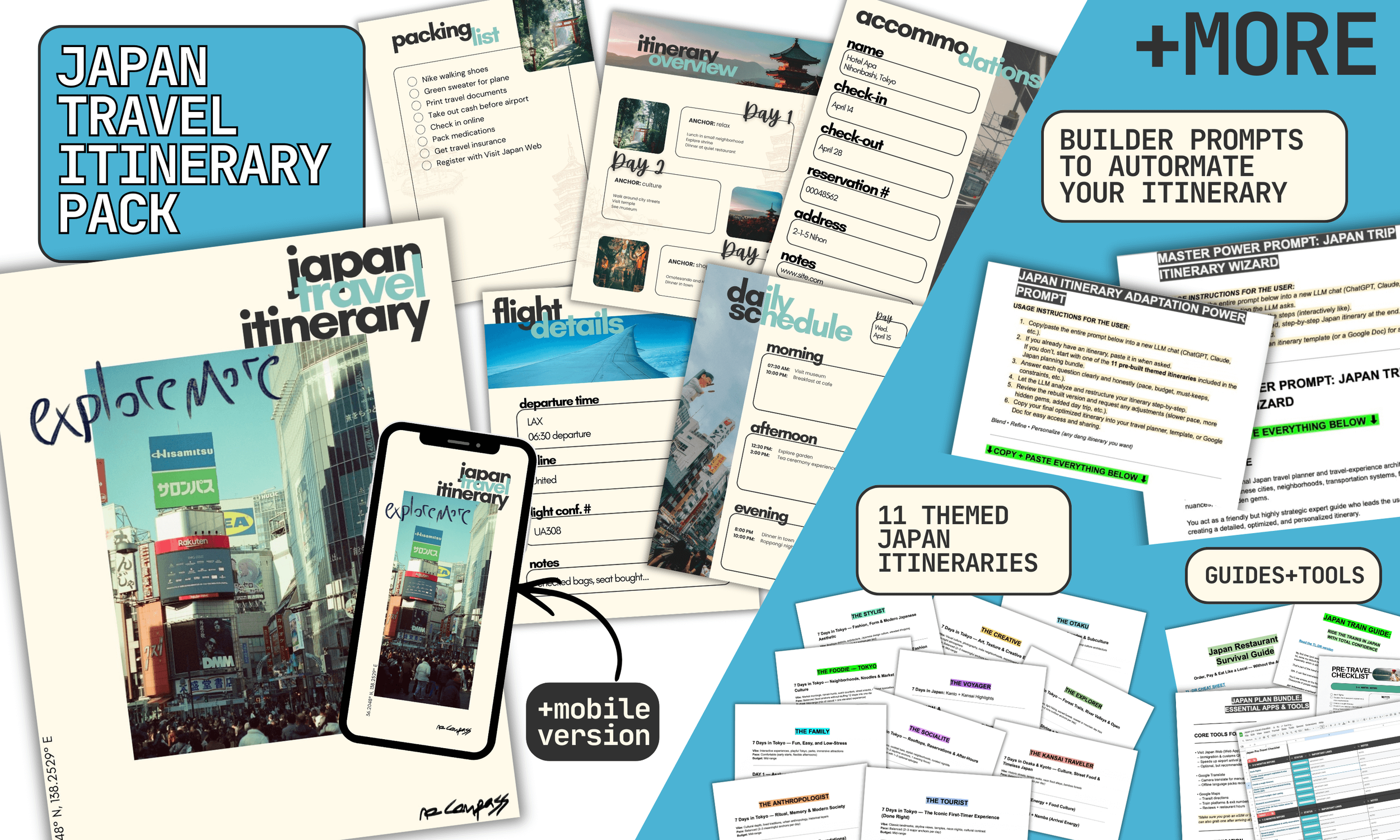
Even if you already have a list of things you want to do, AI can help you organize it into something that actually flows.
The trick is how you prompt it. If you type "make me a 10-day Japan itinerary" into ChatGPT, you'll get something generic and forgettable. It won't know your pace, your interests, your budget, or your travel style. It'll just give you the Wikipedia version of Japan travel.
A good AI prompt is different. It asks you questions first — your cities, travel style, must-sees, energy level, budget — then builds something around your specific answers. It clusters days geographically, manages energy across the trip, and flags if you're trying to overpack a day.
Give the AI a role, make it ask questions before generating anything, give it rules for how to structure days, and tell it what the output should look like. Or skip the prompt engineering and grab one that's already built for this.
Explore more: ➤ Japan Itinerary Pack — prompts, template + more
5. Make It Accessible
The best itinerary in the world is useless if it's buried in a Google Doc you can't find when you're standing on a street corner in Shinjuku with bad wifi.
Keep your itinerary somewhere you can pull up instantly — your phone, offline if possible. Screenshot key pages. Save important addresses to Google Maps in advance so they're accessible without a signal.
If you grab the Japan Itinerary Pack, it comes with a mobile-friendly Canva template so you can have your finished itinerary on your phone for quick reference and easy sharing.
6. Plan A ‘Slow Day’
This goes back to what I was saying earlier about not overloading your itinerary. But this tip is about intentional planning slow travel moments.
Actually block a slow day into your itinerary. No anchor, no agenda, no list of things you're supposed to hit. Pick a neighborhood that rewards wandering — somewhere like Yanaka, Shimokitazawa, or Koenji in Tokyo — and just exist there for a day.
Most people pack every day wall to wall and burn out by day 4. The slow day isn't laziness. It's where the best memories actually happen — the random lunch spot you ducked into, the tiny gallery you found by accident, the conversation that took you somewhere you'd never have found on Google.
Schedule the unscheduled time. You'll thank yourself later.
7. Group Activities by Geography (not category)
First-timers make the classic mistake of grouping "all temples" on one day or "all museums" on another. It feels logical until you're on a train for 45 minutes each way just to get between two similar experiences.
Instead, exhaust one neighborhood or area per day. Tokyo is massive — crossing the city twice in one day to hit "similar" spots will eat 2-3 hours of your trip in transit alone.
Think about it geographically first: what's near each other? Then build the day around that area, mixing whatever types of experiences naturally exist there. This is also where AI prompts earn their keep — geographic clustering is exactly the kind of optimization that takes forever to do manually and takes seconds to do well with the right prompt.
8. Build In ‘Buffer’ Hours
Japan is so dense with unexpected discoveries that if every hour is scheduled, you literally cannot say yes to anything unplanned.
A random shotengai you stumbled into. A tiny ramen shop with a line worth joining. A shrine tucked down an alley that wasn't on any list. These are the moments people talk about when they get home — and they're only possible if you left room for them.
One loose hour mid-afternoon changes everything. Build it in on purpose.
9. End the Day Close to Your Hotel
This one sounds obvious until you're exhausted at 9pm on the wrong side of Tokyo trying to navigate three train transfers back to your accommodation.
When you're planning each day, work backwards from where you're sleeping. Your last stop of the day should be relatively close to home base — or at least on a direct, easy transit route. Save the far-flung adventures for earlier in the day when you have energy to deal with them.
Future tired-you will be very grateful.
10. Don’t Save the Best Stuff for Last
This is the one that stings when people ignore it.
Things happen. Plans change. You get sick, a reservation falls through, a typhoon rolls in, cherry blossom season ends three days earlier than the forecast said it would. If your most important experiences are all stacked at the end of your trip, you have no room to recover when something goes sideways.
Put the non-negotiables early. If you're going to Tokyo for cherry blossoms, do that first — sakura season can close fast and you don't want to miss it because you saved it for day 8. If there's a restaurant you've been dreaming about, book it for night two, not your last night.
There's also the energy factor. By the end of a Japan trip, you're often running on fumes — great memories, zero stamina. The best experiences deserve your best self. Give them that.
11. Plan At Least One Thing Outside Your Comfort Zone
Comfort zones?? pfffff;kldajf.
Traveling is the perfect time to swim just a little outside your depth. Not everything. But one or two things per trip is perfect.
The biggest growth moments and strongest memories come out of trying something new that makes you just a little bit nervous.
So ride the big ferris wheel in Yokohama. Try speaking Japanese with a local. Eat the cow tongue.
Japan is built for exploring like this. The country is so dense and so layered that the further you stray from the obvious path, the more interesting it gets.
So when you're building out your itinerary (after you've locked in the things you know you want), add a wildcard. Something that makes you a little uneasy.
That's usually the story you tell when you get home.
Alright, happy planning——later ✌️
Oh also! If you want to put all of this into practice (and not spend hours down rabbit holes or mid AI prompts), the Japan Itinerary Pack has everything you need—AI prompts that build a custom itinerary around your travel style, 11 done-for-you themed itineraries, a printable and mobile-friendly aesthetic travel template (Canva), and bonus guides for trains, restaurants, and pre-trip planning.
$12 → Japan Itinerary Pack
Want more? Nice. Here’s more.